When I first read Viktor Frankl’s Man’s Search for Meaning almost a decade back, I was both deeply moved and unsettled. Not just by his words, but by the accounts of the horrors he and others endured in Nazi concentration camps, the violence, the dehumanization, the endless uncertainty, the immense suffering, loss of treasured possessions, death of loved ones, and the grief and pain that came with it.
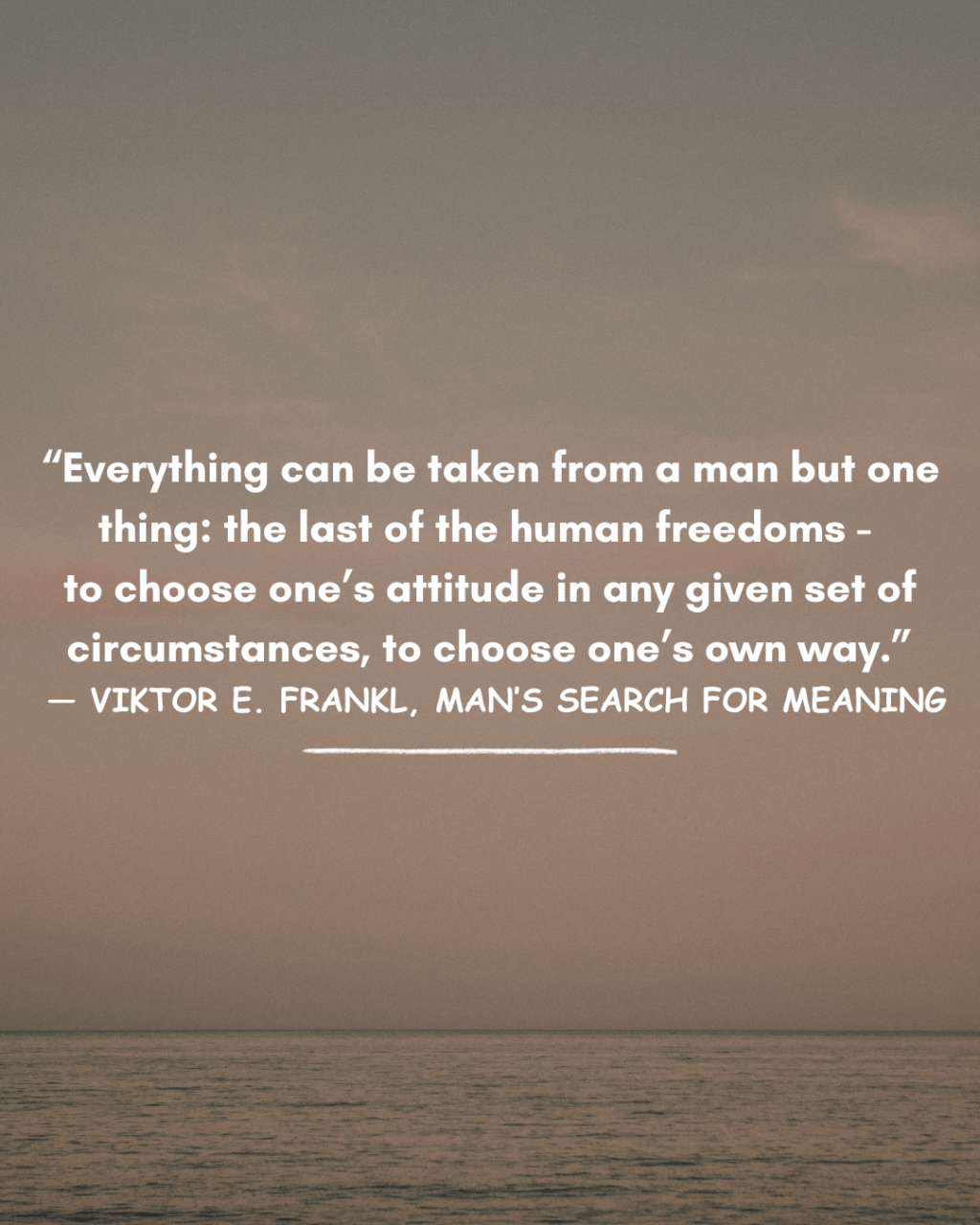
Frankl, in his book, wrote, “Everything can be taken from a man but one thing: the last of the human freedoms — to choose one’s attitude in any given set of circumstances, to choose one’s own way.”
While I was left inspired and empowered by the idea that we can change our lives by making wise choices through our thoughts and attitudes, I was also left conflicted. Reading about the horrific experiences people endured, the violence, the degradation, the unimaginable suffering; I couldn’t help but ask: How could someone, amidst such overwhelming pain and loss, still speak of choosing one’s attitude?
How could attitude, in the face of such inhumanity, still be considered a choice? Was it really possible that even when everything around a person is collapsing; when freedom, rights, safety, and loved ones are taken away, the way one chooses to perceive the situation will somehow help in some way transform a bit of the pain and hurt?
Over the years, through reading, learning, and working as a therapist, I’ve come back to Frankl’s words with a deeper understanding. He never said that choosing our attitude is easy, or that we must force ourselves to be positive or believe that everything will be okay if we just think optimistically. In fact, Frankl understood that as human beings, we often just do the best we can to help ourselves, even if that means escaping, denying, or simply holding on to hope in small ways, in presence of dire external factors.
Sometimes, even with all our planning, strength, and effort, things still fall apart. And when that happens; when we feel we’ve done everything we could, he reminds us that one thing still remains- the freedom to choose how we see our situation. This ability to choose our attitude is something no one can take away from us. No matter what is happening around us, we can still decide what kind of meaning we want to give to our experience. We can still choose how we want to respond to it.
Frankl talks about meaning-making: a process where we try to make sense of what has happened, what it might be teaching us, and how our experiences can shape our actions moving forward. Examples of questions that help in meaning-making are – Why did this happen? What purpose could this serve in my life? How can I grow from this pain or loss? In hard times, these questions help us not just to get through, but to move forward with strength and purpose.
Frankl wasn’t advocating for bypassing pain. He was pointing to something profoundly human: that even when we’ve exhausted every external option, when control is lost and circumstances are unbearable, there is still one inner space of freedom that remains — our attitude, our internal response. That space, as small as it may feel, is sacred. No one can take away what we choose to hold in our minds — the thoughts we nourish, the meaning we seek, or the hope we return to.
This, Frankl says, is the last of the human freedoms, not because it is easy, but because it stays even when everything else has been taken away. So what does the freedom to chose one’s attitude looks like? This is what I’ve come to see in my work — and in myself: that this “choice” to decide our attitude may look like many small, brave acts, such as:
- Choosing to ask for help, even when we’re afraid to seem weak.
- Choosing to accept our limitations with kindness and self-compassion.
- Choosing to be gentle and caring toward one’s identity- whether it’s gender, sexual orientation, ethnicity, socioeconomic status etc, even when those around you don’t support or understand it.
- Choosing to speak up, even when our voice trembles.
- Choosing to feel fully, grief, anger, hope, joy without any judgement.
- Choosing to take a break, or to begin again.
- Choosing to get out of bed when everything feels heavy.
- Choosing to set boundaries even when it is difficult and impossible.
- Choosing to let yourself cry, instead of pretending you’re okay.
- Choosing to believe your story isn’t over, even when part of you wants to give up.
- Choosing to sit and embrace your pain instead of running from it.
- Choosing to believe that something new and meaningful can still emerge from this moment.
These are just a few examples. The choices we make are often difficult and usually come after a long struggle. They require courage, patience, some prior work in finding ways to cope, and a lot of self-love. But by making these choices, we exercise the last human freedom — the freedom to choose our attitude — and in doing so, we create space for healing and growth.
I’d like to conclude with two powerful quotes from Viktor Frankl’s Man’s Search for Meaning:
“Between stimulus and response there is a space. In that space is our power to choose our response. In our response lies our growth and our freedom.”
“When we are no longer able to change a situation, we are challenged to change ourselves.”


 Chai Time Ruminations
Leave a Reply