
There are times when you may have heard, or even told someone expressing worry or anxiety, “Oh, it’s just all in your head.” I’m sure you didn’t mean any harm. Sometimes, these words come not from malice, but from a lack of understanding of what is exactly happening.
But what if I told you that what you think about often shows up in your body and vice-versa? This is precisely what research highlights. It shows immense evidence for the mind-body connection. What you think about often manifests in your body. And what you feel in your body, may also bring about some related thoughts.
Let’s take a moment and play a quick game using our imagination.
- Imagine you have a slice of ripe, yellow lemon. Now imagine you are cutting it into two halves. Next, imagine you bite into it and notice what’s happening in your body?
Did you notice yourself reacting like you were actually eating a real lemon, experiencing a similar taste and physical reaction in your body? Yes, that’s exactly what’s happening: your mind created a physical response.
- Now imagine a recent memory that made you happy. Notice what it does in your body- maybe you are smiling or you recall even more pleasant memories coming up, or you feel your body relax.
- Now, imagine or think of something that is bothering you and see how it shows up in your body. Take a moment to see what’s happening in your body.
Now take a pause and breathe, relax your body.
It’s also important to note that sometimes, worry and anxiety can stem from external factors, personal conditioning, or simply a lack of knowledge about effective coping strategies. Learning to manage your thoughts and emotions and developing effective coping strategies can help alleviate these feelings. Seeking professional help (from a mental health professional or medical professional) to manage these feelings is often the right and appropriate way to tackle them.
So, what’s happening at a biological level?
- The autonomous nervous system- Sympathetic and Parasympathetic nervous system
Now, let’s say you have a recurring thought, “I’m anxious something is going wrong,” or “I’m worried how this will turn out.” Here’s what happens in your body:
The autonomic nervous system (a part of the peripheral nervous system that regulates involuntary body functions) gets activated.
This system is made up of the Sympathetic Nervous System (responsible for ‘fight-flight-freeze’ responses) and the Parasympathetic Nervous System (responsible for ‘rest and digest’). From a survival and evolutionary perspective, these systems work to help us survive and fight off stressors and return to normalcy once the threat is at bay.
So, what generally happens in a sympathetic state? You might notice your heartbeat increase, your breathing quicken, your muscles tense, or your palms get sweaty. These are your body’s ways of preparing you to either confront or escape the perceived danger.
In the parasympathetic state, the body relaxes once the threat is no longer there. Or once it receives cues that you are safe and can cope with the stressor. Your heart rate slows, breathing normalizes, and your muscles relax – allowing for recovery and relaxation.
- The Polyvagal Theory
More recently, Stephen Porges’ Polyvagal Theory has further illuminated what happens within the body when we’re stressed. It suggests our nervous system has three main states that guide our responses to safety and danger. These are the Ventral Vagal , the Sympathetic, and the Dorsal Vagal states.
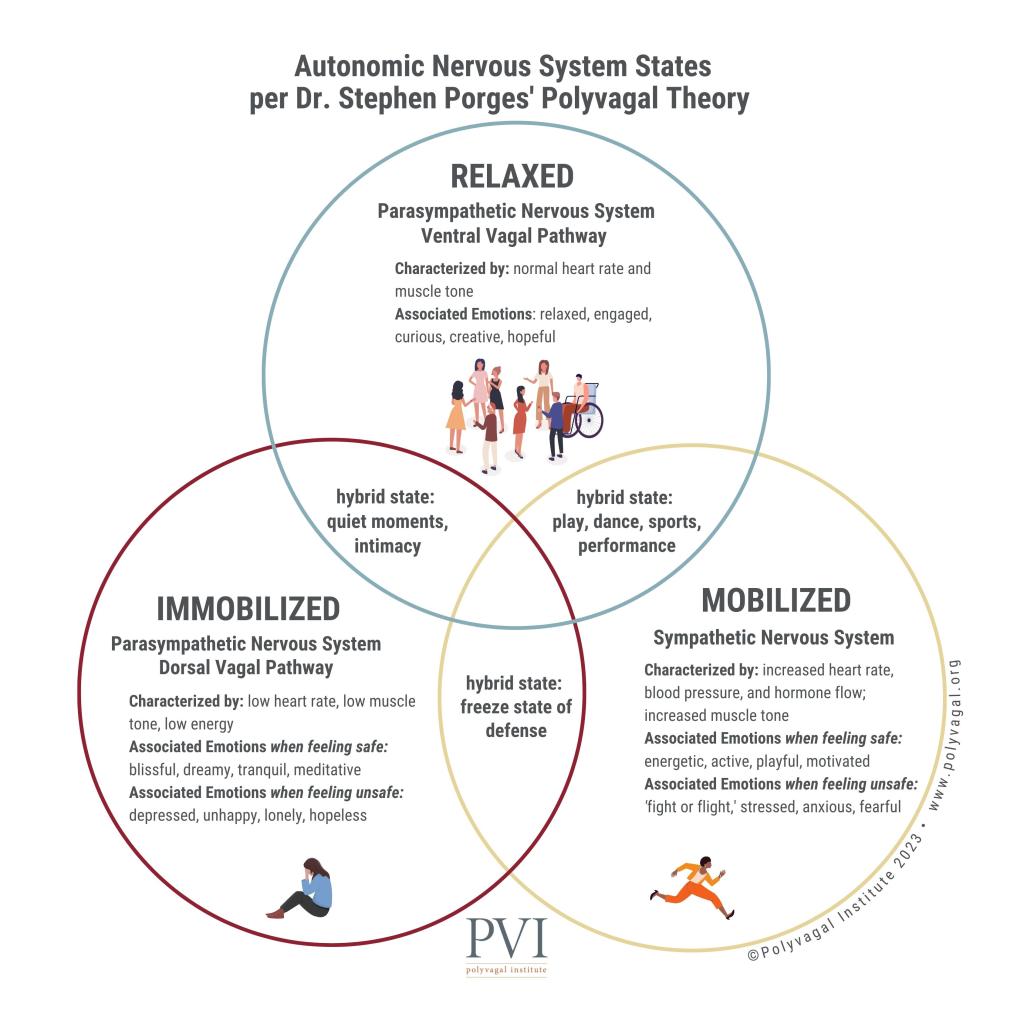
Understanding these helps us better manage our body’s reactions and seek true feelings of safety.
3. Further, when stressed, hormones like cortisol, adrenaline, noradrenaline, are released in the body. These hormones trigger the sympathetic nervous system, further preparing your body to ‘fight off’ stressors.
Now, imagine the prolonged impact of chronic stress on your body, especially if you’re constantly in a ‘fight-flight-freeze’ state. Fields like psychosomatic studies (which examine the relationship between mind and body in health and disease), psychoneuroimmunology (the study of the interaction between psychological processes and the nervous and immune systems), and trauma-informed care are uncovering crucial effects. The mind-body connection is not a myth; it’s real and backed by science.
Ultimately, taking care of yourself by managing your thoughts, behaviour and emotions is crucial for your overall well-being. Understanding this profound connection between your mind and body empowers you to take appropriate steps towards a healthier and more balanced life.
Psychological distress and disorders are very real. What you experience in your body or in your ‘head’ can be dealt with effectively through thorough and appropriate care, via timely intervention.
Seeking psychological help is therefore not only natural but important, and it can prove very effective long-term. This is because what you’re experiencing isn’t “just in your head”; it’s also showing up in your body and vice-versa, and both aspects can be addressed.

 Chai Time Ruminations
Leave a Reply