
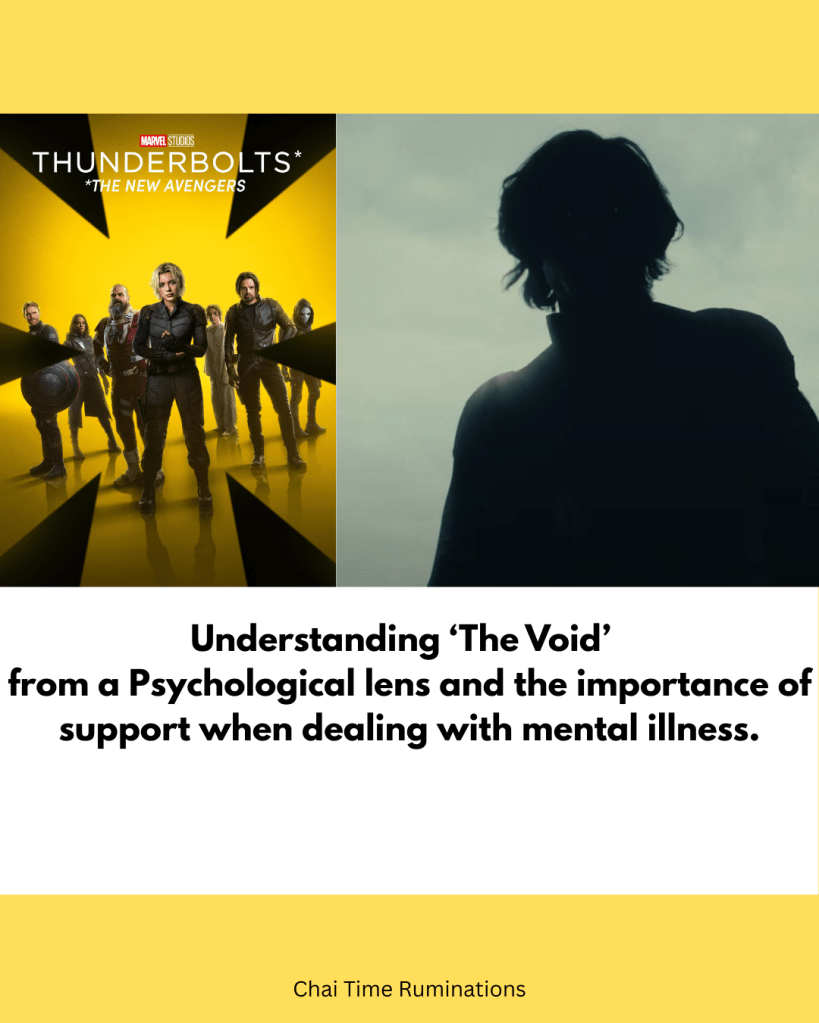
Bob endured a traumatic childhood, marked by abuse, guilt, constant blame and grew up feeling depressed. Later, in an attempt to cope with the emotional pain, he dealt with substance abuse abuse to numb the pain.
Later, Bob is recruited into a secret medical trial that unlocks his superpowered alter ego, ‘Sentry’ while also creating ‘The Void’
The Void -a physical manifestation of Bob’s repressed trauma.
The Void becomes a destructive force not only threatening Bob himself, but everything and everyone around him.
While appearing to be a villain, The Void is a complex being, shaped by repressed battles with unpleasant emotions that have built up over the years.
The Void traps Bob and the others in an interconnected shame room-a symbolic space made up of different places of hurt and pain that each person has experienced over time.
We see, both, Yelena’s and Bob’s shame rooms, and these scenes highlight how painful, repressed emotions can trap a person and cause deep internal harm when left unprocessed.
It becomes clear that coping with such pain is not easy to do alone.
When the other members of the Thunderbolts arrive in the shame room, they reinforce the importance of being together and facing these emotional wounds as a team, once again emphasizing how supporting someone in their battle with mental illness is not only helpful, but necessary.
When Bob is left to fights off the Void alone, after it has trapped the others, the Void almost completely consumes him.
It repeatedly tells him, “You don’t matter to anyone. It will always just be us”; mimicking what often happens in those suffering and battling with depression-unpleasant emotions bring about unpleasant thoughts.
These words intensify Bob’s unpleasant emotions even further, overwhelming him with feelings of shame, sadness, and worthlessness.
This is where an important psychological theory helps us understand what’s happening: Aaron Beck’s Cognitive Triad of Depression. Beck explains how unpleasant emotions, such as those found in depression, can distort a person’s thoughts.

According to this theory, depression is intensified through three core distorted thoughts and views-
- About the self: e.g. “I am worthless.”
- About the world: e.g.“No one cares about me.”
- About the future: e.g. “Things will never get better.”
The Void’s words reflect all three of these distortions, showing how emotional pain and depression can take over a person’s inner world and make it feel impossible to escape, especially when faced alone, or may make one feel alone and isolated even when someone is there around.
Although Yelena and the others continuously reassured Bob that they were there to support him, the Void’s voices grew louder and more intense. It wasn’t until the others broke free from their own physical restraints and surrounded Bob in a powerful show of strength and solidarity that he truly felt he was not alone. Together, they were able to overcome the Void and emerge victorious.
The Thunderbolts reach out to Bob not to fix him or fight his battle, but to stand by him and support him.
In this deeply moving moment, they remind him that he is not alone, and that support matters. With their help, Bob is finally able to reduce the intensity of the Void, regaining control.
Together, they manage to save the world, once again from the negative impact of The Void.
The Thunderbolts, now renamed as the new Avengers, get ridiculed for their past history of not really being ‘good all along’.
But hey, everyone deserves a second chance at redemption, especially when they are making an effort.
The movie effectively captures the importance of supporting someone battling mental illness. It is important to note that there is no shame in seeking professional help. Medical and therapeutic support is not just helpful, it’s often crucial.
It’s worth noting that Bucky Barnes has received therapy to cope with his own trauma, as seen in The Falcon and the Winter Soldier.
Interestingly, in the shame room scene, when Yelena asks how he’s doing, he replies, “I am fine. I have a great past.” Sure, it’s a bit ironic considering everything he’s been through, but it also could suggest that he may have found ways to process his pain and cope more effectively with the help of psychotherapy.
So honestly, it wouldn’t be surprising if, in future Marvel films, we see more superheroes seeking therapy.
And why not? Saving the world is no small task.
It’s emotionally and mentally exhausting.


 Chai Time Ruminations
Leave a Reply